
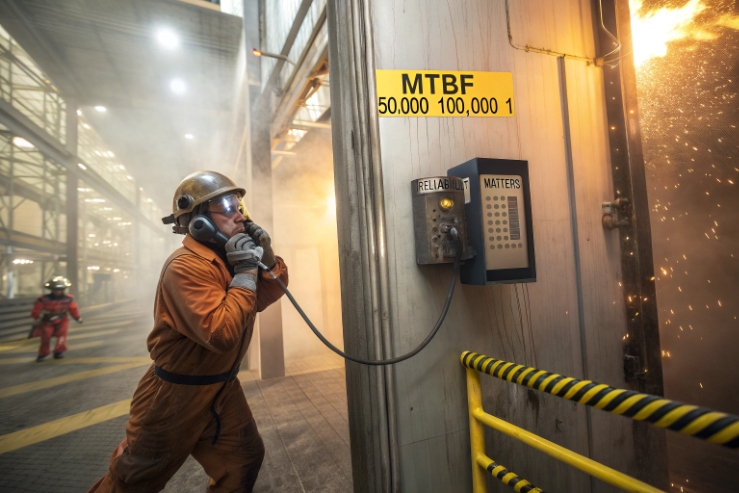
Emergency phones sit in the worst corners of a plant. When one unit fails, people lose a safety path. That risk is bigger than the device price.
MTBF is a statistical reliability metric, not a promise of lifetime. For explosion-proof telephones, it is usually predicted (MIL-HDBK-217F or Telcordia SR-332) or estimated from field failures, and common quotes fall around 100,000–300,000 hours depending on assumptions.
MTBF is useful only when the boundary and the environment are stated
What MTBF means in plain terms
MTBF stands for “Mean Time Between Failures.” In bids, it often appears as one number. That looks simple, but it hides three choices: what counts as a failure, what parts are included, and what environment the calculation assumes. In most prediction standards, the math also assumes a constant failure rate 1 during “useful life.” That is fine for many electronic parts, but it does not describe wear-out for keypads, hook switches, and relay contacts.
For explosion-proof telephones, the enclosure and certification protect against ignition and harsh exposure. They do not automatically raise MTBF. The MTBF calculation 2 comes from the internal design, parts quality, sealing, thermal design, and the real stress profile on site.
What buyers should demand in a tender
A serious MTBF statement should include:
- Method used (field data, MIL-HDBK-217F, SR-332, or other)
- Environment class and temperature
- Assumed duty cycle (idle, ringing, paging, relay switching)
- The “item” definition (whole phone, electronics only, or module level)
- Exclusions (handset cord, lightning damage, misuse, corrosion)
My simple way to compare MTBF claims
When two suppliers give different MTBF numbers, the higher number is not always better. It often means the assumptions are more “gentle.” I prefer a vendor who explains assumptions and provides a service strategy. That is what keeps a site running.
| What is specified | Why it changes MTBF | What to ask for |
|---|---|---|
| Environment and temperature | Heat drives failure rate up | “Which temperature and environment class?” |
| Failure definition | Cosmetic issues vs service-impacting faults | “What is counted as a failure?” |
| Included parts | Handset, keypad, relays can dominate | “Does it include electromechanical parts?” |
| Duty cycle | Relay switching and paging add stress | “What is the assumed use profile?” |
If the MTBF number in a datasheet has no method and no assumptions, treat it as a marketing hint, not an engineering input.
Now it makes sense to look at how MTBF is determined and how to read each method.
In the next sections, I break down the standards, typical MTBF ranges, which subassemblies are really covered, and how reliability test programs and warranty terms should change a bid evaluation.
How is MTBF determined—field failure data, MIL-HDBK-217F, or Telcordia SR-332?
A single MTBF number can come from three very different worlds. If the source is unclear, comparisons are not fair and risk stays hidden.
MTBF is determined either from field failure rates, or from reliability prediction standards like MIL-HDBK-217F or Telcordia SR-332. Field data reflects reality but needs enough volume and clean tracking. Prediction models are fast but depend heavily on assumptions.
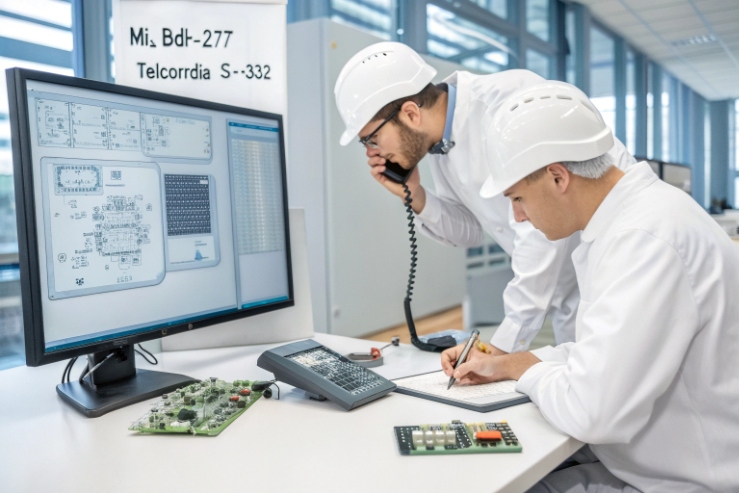
Field failure data: the best mirror, but hard to collect well
Field failure data 3 usually comes from RMA records and installed base tracking. The basic logic is simple: failures divided by total operating hours. The hard part is discipline:
- Units must be tracked by serial number and install date.
- Failures must be categorized (no fault found vs real defect).
- Exposure must be comparable (one site may be hot, another may be coastal).
- Early failures should be separated from long-term failures.
Field MTBF becomes meaningful when there is enough volume. For niche hazardous-area devices, volume can be limited. So field numbers often have wide confidence bounds unless the vendor has a large installed base.
MIL-HDBK-217F: component-based prediction
MIL-HDBK-217F 4 predicts failure rates for electronic equipment using component models and factors for temperature, environment, and quality. Many teams use either a “parts count” approach early, or a “parts stress” approach when design details are known. The output is usually a failure rate (λ). MTBF is then treated as the inverse of that rate for a constant-rate model.
This method is useful for comparing design choices. It is less useful for claiming real-world lifetime unless the environment factors match the site.
Telcordia SR-332: telecom-style prediction with different assumptions
Telcordia SR-332 5 is also a prediction procedure. It is widely used in telecom equipment contexts. It can incorporate part stress, quality, and environment, and it is often paired with system availability modeling.
The practical difference in bids is not “which is right.” The difference is “are we comparing like with like.” A SR-332 MTBF and a MIL-HDBK-217F MTBF can diverge even for the same product.
| MTBF source | Strength | Weak point | Best use in a tender |
|---|---|---|---|
| Field MTBF | Reflects real usage | Needs volume and clean data | Qualification and long-term supplier selection |
| MIL-HDBK-217F | Transparent factors and part models | Can be optimistic if environment is gentle | Engineering comparison and baseline prediction |
| Telcordia SR-332 | Telecom-focused framework | Still assumption-driven | System availability modeling and telecom bids |
What MTBF range is typical for explosion-proof telephones—100,000 to 300,000 hours?
People often ask for one “normal” MTBF number. In reality, MTBF is a range shaped by assumptions and what parts are included.
A typical quoted MTBF for industrial and explosion-proof telephones is often around 100,000 hours, and higher claims up to 300,000 hours can appear when predictions assume benign environments, limited mechanical wear, and high-quality components. The usable number depends on your site conditions and the failure definition.
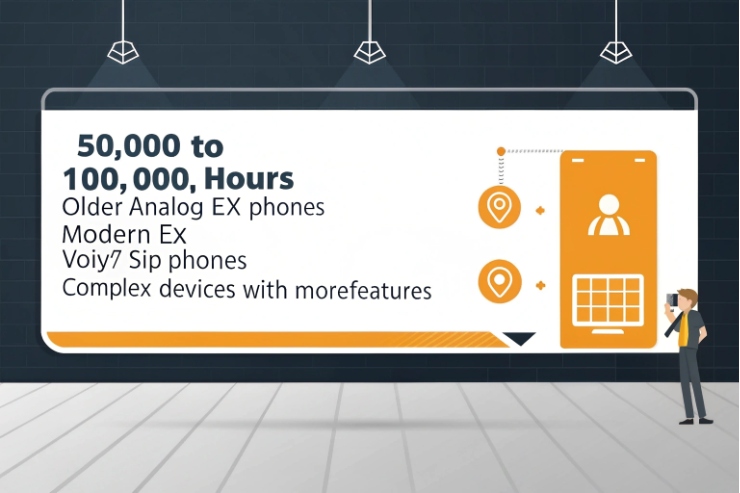
Why 100,000 hours shows up so often
Many industrial telephone datasheets state MTBF near 100,000 hours. That number is easy to quote and can align with common prediction outputs under moderate assumptions. It also maps to a simple message: “built for long uptime.” Still, it should not be read as “11.4 years guaranteed.” It is a statistical mean under a model.
Why some bids show 200,000–300,000 hours
Higher MTBF values often appear when:
- The environment is modeled as “benign” or “controlled.”
- The internal design uses fewer high-risk parts.
- The prediction excludes high-wear elements like hook switches.
- The duty cycle is low (mostly idle, few relay operations).
This does not mean the claim is wrong. It means the scope is narrower. For harsh sites, the real failure drivers are often thermal cycling, corrosion, cable entry quality, and surge exposure. Those drivers can dominate and are not always captured well by simple prediction numbers.
Do MTBF figures cover handset, keypad, and relays under extreme temperature, vibration, and humidity?
Many end users assume MTBF covers “everything in the box.” Many prediction reports cover only the electronics. That gap is where warranty arguments start.
Sometimes. MTBF may cover the full assembly only if the vendor defines it that way. Many prediction methods focus on electronic components and may not represent wear-out of handset cords, keypad membranes, hook switches, and relay contacts, especially under extreme temperature cycling, vibration, and humidity.
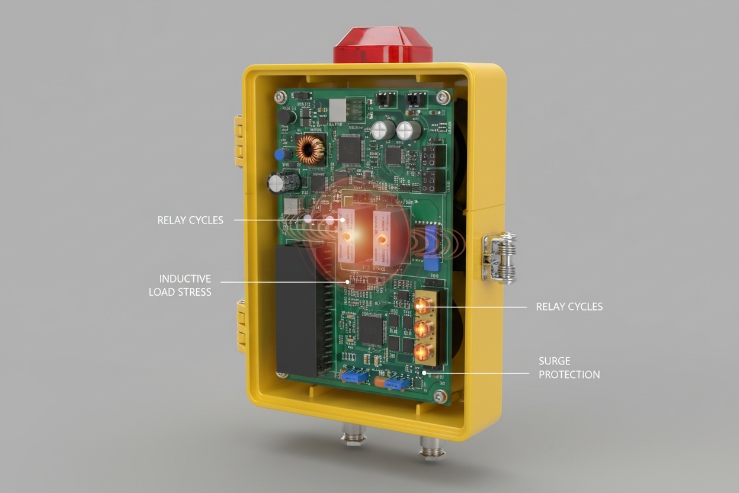
Define the “item” clearly: electronics vs full product
A complete explosion-proof telephone includes components that are often assessed using different reliability prediction models 6.
- Mainboard electronics (CPU, PHY, DC/DC, audio amp)
- Handset and cord (mechanical flexing and connector strain)
- Keypad (membrane aging, seal fatigue)
- Hook switch or magnetic sensor (mechanical cycles)
- Relays and I/O (contact wear, coil heating)
- Cable glands and sealing system (installation-sensitive)
MIL-HDBK-217F and SR-332 are strongest on electronic parts. They are weaker at describing mechanical wear. Vendors can still include relay failure models, but the results depend on accurate duty cycle assumptions.
Extreme environments create failure modes MTBF often misses
In harsh sites, failures often come from:
- Condensation and moisture ingress due to thermal cycling
- Corrosion on terminals and PCB pads
- Vibration loosening fasteners or stressing solder joints
- Seal aging and cable entry mistakes
- Handset cord fatigue from repeated pulls
How do burn-in, HALT/HASS, component derating, and warranty terms influence MTBF in bids?
Reliability programs can raise real-world uptime, even when the datasheet MTBF stays the same. Warranty terms also reveal how confident the supplier is.
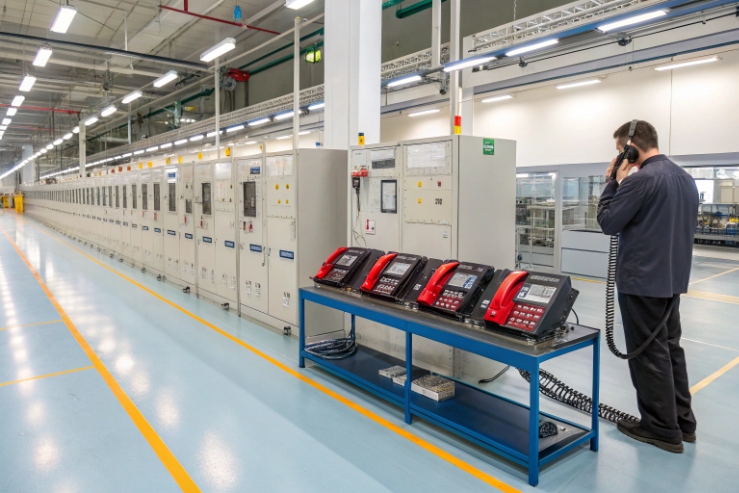
Burn-in and HASS remove early-life defects. HALT finds design margins and weak points during R&D. Component derating reduces stress and often improves reliability. Warranty terms and exclusions show what the supplier is willing to stand behind, which matters more than a single MTBF number.
Burn-in and HASS: screening, not magic
Advanced HALT and HASS testing 7 are often used as production screens. The goal is to catch weak units before shipping. That reduces early failures and lowers support cost. It does not guarantee zero failures, but it shifts the curve so the site sees fewer “dead on arrival” and fewer first-month issues.
Component derating: the quiet driver of real uptime
Derating means running parts below their maximum ratings. In industrial phones, derating shows up in:
- DC/DC converters with headroom
- Capacitors with higher temperature ratings
- Relays not run near their switching limits
- Surge and transient protection sized for field reality
Warranty terms: the practical truth in contracts
Warranty terms influence how MTBF is judged in tenders:
- A longer warranty with clear RMA terms often signals confidence.
- Exclusions matter, especially for lightning, corrosion, misuse, and third-party power issues.
- Spare parts availability and lead time affect MTTR, which affects uptime.
Conclusion
MTBF for explosion-proof telephones is meaningful only with method, environment, and scope. Use MTBF with test evidence, derating, and warranty terms to judge real uptime.
Footnotes
-
An assumption that the probability of failure remains steady over the useful life of a product. ↩ ↩
-
The statistical formula used to estimate the average time elapsed between inherent failures of a system during operation. ↩ ↩
-
Real-world performance records collected from equipment installed and operating in actual field environments. ↩ ↩
-
A military handbook providing standard procedures and data for reliability prediction of electronic equipment components. ↩ ↩
-
A widely used telecommunications industry standard for predicting the reliability of electronic equipment. ↩ ↩
-
Mathematical frameworks used to estimate MTBF based on historical data and component stress analysis. ↩ ↩
-
Accelerated life testing techniques used to identify design weaknesses and screen production defects during manufacturing. ↩ ↩








