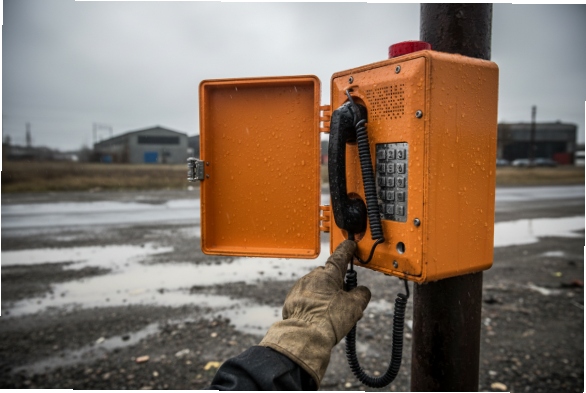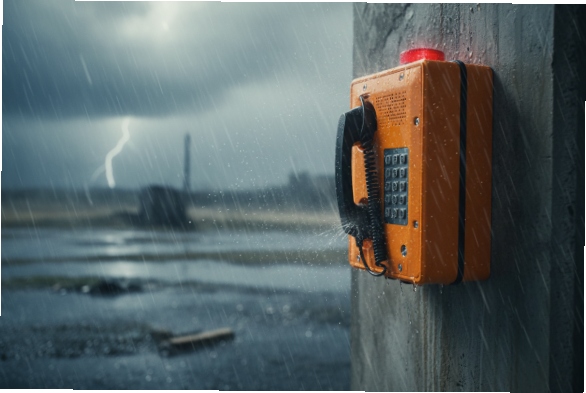
Coastal air can ruin outdoor phones faster than rain. Corrosion starts at tiny edges, then seals loosen, and the “IP-rated” device begins to leak.
A good salt-fog requirement is not just “hours.” It combines the right standard (NSS/CASS), a realistic duration, clear pass/fail criteria, and proof that the full assembly (fasteners, glands, gaskets) matches the tested build.
Salt-fog rating is a system requirement, not a coating slogan?
Why “salt-fog hours” alone is a trap
Many tenders ask for “1000 hours salt spray.” Then suppliers submit random screenshots, and the project still fails after two winters. The reason is simple: salt-fog tests are accelerated screening. They reveal weak spots in materials and coatings. They do not directly convert into “X years offshore.” The correct way is to define:
- which method is used (neutral vs acid vs copper-accelerated)
- what parts are tested (enclosure, brackets, fasteners, glands, nameplates)
- how samples are prepared (scribed or not, cut edges, assembled with gaskets)
- what counts as failure (red rust, blistering, creepage, functional problems)
The “whole entry system” matters most
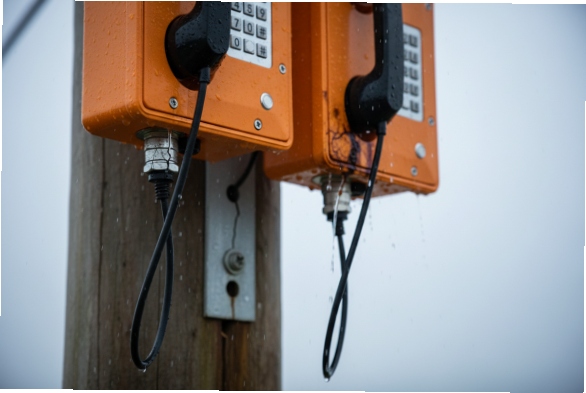
On weatherproof telephones, corrosion often begins at:
- screw heads and washers
- cable glands and locknuts
- mounting brackets and sharp edges
- coating damage during installation
- crevices where salt water can sit
So the salt-fog requirement should cover the full outdoor build, not only the enclosure shell.
A simple way to define salt-fog performance for telecom sites
| Site class | Typical environment | Recommended test approach | Procurement goal |
|---|---|---|---|
| Coastal onshore | Salt air + rain + sun | ISO 9227 NSS 1 or ASTM B117 salt spray 2 + clear acceptance limits | No functional corrosion failures |
| Coastal industrial | Salt + chemicals + washdown | NSS plus material constraints + gasket choice | Stable seals and hardware |
| Offshore / near-splash | Salt spray + heat + high humidity | NSS plus cyclic offshore coating test (if coatings are used) | Long-life surface and fastener package |
A short personal lesson fits here: many “failures” blamed on the phone were actually caused by non-rated site hardware. If the tender does not lock down glands and fasteners, installers will substitute cheaper parts. Corrosion then starts at the entry point and spreads.
The next sections break the decision into four clean steps: standards and durations, materials and coatings, component-level corrosion control, and documentation that protects long-term deployments.
A strong salt-fog spec also makes vendor comparisons easy.
Which standards and durations apply—ASTM B117 or ISO 9227 NSS/CASS—for coastal or offshore sites?
Salt spray sounds like one thing, but the standard you choose changes the chemistry and the severity. Using the wrong method can reject good designs or approve weak ones.
For most coastal telecom enclosures, use ISO 9227 NSS (or ASTM B117, which is similar in intent). Use ISO 9227 CASS only when you need a more aggressive, acid/copper-accelerated test for specific plated/coated parts. For offshore, consider adding cyclic offshore coating testing instead of only increasing NSS hours.
NSS vs CASS in plain language
NSS (Neutral Salt Spray)
This is the common baseline. The chamber runs a neutral salt fog using a 5% sodium chloride solution at controlled temperature. It is widely used to compare metals and coatings and to find pores, scratches, and weak edges.
CASS (Copper-Accelerated Acetic Acid Salt Spray)
This is a harsher method. It uses an acidified salt solution with copper chloride. In specifications, CASS is often referenced via the ASTM B368 CASS test method 3. It accelerates attack and is often used for decorative or plated coating systems and anodized aluminum checks. It can be too aggressive for “general outdoor telecom” unless the buyer knows exactly why it is needed.
Practical duration guidance (tender-friendly)
Standards define the method. Your project defines the duration and the acceptance criteria. For weatherproof telephones, durations are usually chosen from risk, not from a universal rule:
- Coastal onshore (general): many projects choose 240–720 hours NSS as a screening level.
- Harsh coastal / industrial coastal: many projects choose 720–1000 hours NSS, plus stricter requirements for fasteners and glands.
- Offshore / near-splash: many projects choose 1000+ hours NSS, but the best improvement usually comes from adding cyclic offshore coating validation aligned to ISO 12944-9 offshore coating performance requirements 4 for coated parts.
If CASS is required, keep it scoped:
- Use CASS for the specific parts where plated finish or anodized aluminum is being evaluated.
- Do not treat CASS as the default for every part of a weatherproof telephone.
How to write the standard line so it cannot be misread
| Tender line | Good wording | What it prevents |
|---|---|---|
| Test method | “Salt spray per ISO 9227 NSS (or ASTM B117 NSS)” | Stops mixing acid methods unintentionally |
| Aggressive option | “CASS per ISO 9227 only for plated/anodized parts listed in BOM” | Stops unfair test selection |
| Duration | “Minimum X hours exposure, plus defined acceptance metrics” | Stops “hours-only” marketing |
| Evidence | “Provide full lab report and sample build list” | Stops untraceable claims |
Offshore buyers often ask for “more hours.” In practice, offshore performance improves faster when cyclic tests and corrosion design rules are added, not only NSS time.
The next decision is materials and coatings. That is where most long-life value is won.
What materials/coatings—316L stainless, marine-grade aluminum, powder coat—meet required salt-fog hours?
Coastal corrosion is not polite. It attacks the weakest metal first, then grows around fasteners and edges where coatings are thin.
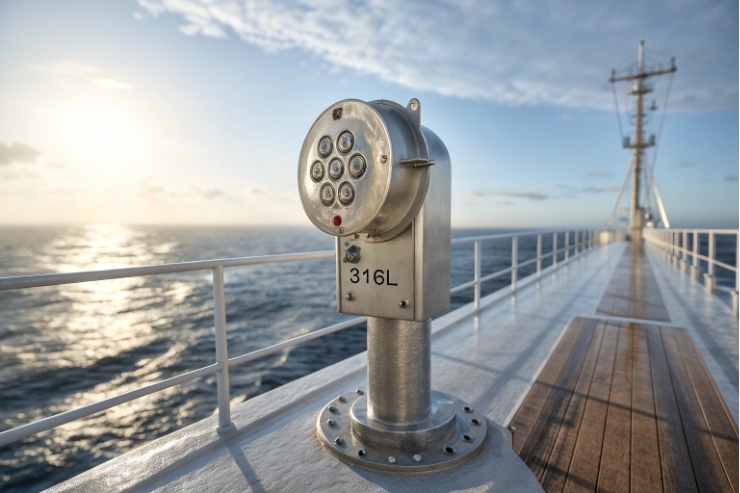
316L stainless is the safest long-term choice for harsh coastal and offshore hardware, marine-grade aluminum can work well with the right surface preparation and coating system, and powder coat performance depends heavily on powder chemistry, film thickness, and edge coverage control.

316L stainless: strong baseline for long-life deployments
316L stainless steel 5 resists chloride environments better than lower grades. For weatherproof telephones, 316L is a common choice for:
- enclosure shells or faceplates
- exposed fasteners and brackets
- nameplates and mounting frames
The important detail is design. Stainless can still suffer in crevices where salt water sits. So drainage, smooth joints, and avoiding water traps matter as much as the metal grade.
Marine-grade aluminum: good performance when the system is controlled
Aluminum can be a strong option for weight and cost, especially with:
- correct alloy selection (project-defined)
- good pre-treatment (cleaning and conversion coating)
- robust coating system
- careful edge design (edges are where corrosion starts)
Without strong edge coverage, powder-coated aluminum can fail at corners and drilled holes. For outdoor telephones, hole edges, cable entry holes, and mounting points need special attention.
Powder coating: specify the system, not the color
Powder coat can perform well outdoors. It can also fail quickly if it is a decorative indoor-grade system. A good tender should specify:
- powder type suited for outdoor UV and marine exposure (project-defined)
- minimum dry film thickness
- scribe/edge performance acceptance (creep limits)
- repair method after installation scratches
“Hours” and “materials” must connect through acceptance limits
| Material/coating choice | What usually performs well | What to specify in tender |
|---|---|---|
| 316L stainless enclosure | Long-life in coastal air | Grade + surface finish + crevice avoidance |
| 316 fasteners + glands | Stable hardware | Same grade for all exposed hardware |
| Coated aluminum enclosure | Good when coating is high quality | Coating system + edge coverage rules |
| Powder coat brackets | Can fail first if thin | Thickness + scribe creepage limits |
A strong approach is to define two packages:
- Coastal package: coated aluminum or stainless enclosure, 316 fasteners, nickel-brass or stainless glands.
- Offshore package: 316L enclosure and hardware, plus cyclic coating proof if any coated parts remain.
Corrosion is often caused by a few small items. Fasteners and glands decide the outcome more than the big metal box. That leads to the next topic.
Are fasteners, cable glands, and gaskets salt-spray rated, and how is galvanic corrosion mitigated?
Many outdoor systems fail because one small part is the wrong metal. Then galvanic corrosion starts, and the phone looks fine but leaks at the entry.
Fasteners, glands, and gaskets should be treated as salt-spray-critical parts. Use consistent corrosion-resistant metals, specify rated glands and washers, choose outdoor-grade gaskets, and mitigate galvanic pairs with isolation, coatings, and drainage-focused design.

Fasteners: the first visible failure
Fasteners often fail first because they are small and exposed. For coastal sites:
- Prefer 316/316L stainless for exposed screws, washers, and brackets.
- Avoid mixing low-grade stainless with higher grade. The weaker grade can become the sacrificial part.
- Use anti-seize where needed to avoid galling and to keep service possible after years.
Cable glands: IP rating is not enough
A gland must do four jobs at once:
- seal against water and dust (IP66/IP67 as needed, per IEC 60529 IP ratings 6)
- survive UV and salt exposure
- clamp the cable without cutting the jacket
- maintain shield bonding if STP is used
For coastal deployments, nickel-plated brass glands are common. For offshore, stainless glands are often preferred. Also, the locknut and sealing washer must match the material class. A stainless gland with a low-grade locknut is still a weak link.
Gaskets: corrosion control is also seal control
Gaskets do not rust, but they fail when:
- UV and heat cause hardening
- compression set reduces squeeze
- salt contamination remains on mating surfaces and causes corrosion that lifts the sealing land
For outdoor weatherproof phones:
- Silicone or high-grade EPDM are common choices for long outdoor life.
- Recessed gasket grooves protect the gasket from direct UV and mechanical damage.
- Even compression matters. Warped flanges create corner leaks.
Galvanic corrosion: prevent the battery effect
Galvanic corrosion mechanisms 7 appear when dissimilar metals touch in the presence of an electrolyte (salt water). It often shows up at:
- stainless screw into aluminum
- brass gland into aluminum panel
- mixed bracket stacks
Mitigation options that work in real builds:
- keep metals compatible where possible
- add isolation washers or bushings
- use barrier coatings at contact points
- avoid water traps and add drainage paths
- seal crevices so salt water cannot sit
| Risk point | Common galvanic pair | Mitigation that works |
|---|---|---|
| Stainless fastener + aluminum | 316 + Al | Isolation washer + coating + controlled torque |
| Brass gland + aluminum | Brass + Al | Nickel-plating, isolation washer, sealing washer |
| Mixed bracket stack | Steel + Al + SS | Standardize materials, add barrier layer |
| Crevice under washer | Any pair + salt water | Drainage, sealing, correct washer design |
A simple rule used in many coastal projects: the hardware set must be one coordinated kit. If the kit is not locked down, substitutions will defeat the salt-fog plan.
Now the final part is proof and accountability. Long-term deployments need more than a datasheet line.
Do certifications, test reports, and warranty terms define salt-fog performance for long-term deployments?
Without documents, salt-fog claims become a sales story. Then when corrosion appears, nobody agrees on what “pass” meant.
Yes. A strong tender should require third-party test reports (with sample configuration), clear acceptance criteria, and warranty terms that define what corrosion is covered (functional vs cosmetic) under real coastal use and maintenance conditions.
What to demand in a test report
A useful salt-fog report should include:
- the standard and method (NSS or CASS)
- duration and inspection intervals
- sample preparation (scribed or not, cut edges, coating thickness)
- assembly condition (gaskets installed, glands installed, fasteners installed)
- photos before, during, and after
- measured results and pass/fail against stated criteria
For weatherproof telephones, it is also smart to request a post-test check:
- gasket sealing check (simple water ingress check on sample units)
- hardware serviceability check (can screws be removed without snapping)
- electrical function check (call, audio, buttons)
Certifications vs corrosion evidence
IP ratings and safety marks do not automatically define salt-fog performance. Salt-fog is usually supported by:
- material declarations (316L, coating system)
- corrosion test reports
- manufacturing controls (coating thickness, surface prep)
So the tender should keep salt-fog as its own evidence track. The goal is to prevent “certified product” from being used as a shortcut to skip corrosion proof.
Warranty terms: write them so both sides understand
A practical warranty statement should define:
- the coverage period for functional failure due to corrosion
- what cosmetic changes are acceptable (tea staining, minor discoloration)
- exclusions (installation damage, wrong cleaning chemicals, non-approved hardware)
- maintenance expectations (rinse schedule for offshore, inspection intervals)
Tender-ready language that reduces disputes
| Document item | Recommended requirement | Why it protects the project |
|---|---|---|
| Salt-fog test report | “Third-party report to ISO 9227 NSS, duration X, with acceptance criteria” | Makes bids comparable |
| Assembly scope | “Report must include fasteners, glands, washers, gaskets as installed” | Prevents weak-link substitutions |
| Acceptance limits | “No perforation, no coating delamination, creepage ≤ X mm from scribe” | Turns hours into outcomes |
| Warranty | “Functional corrosion coverage for coastal kit; cosmetic limits defined” | Prevents vague promises |
| Field rules | “Approved hardware kit only; no substitutions” | Keeps the tested build in the field |
A simple client explanation that works:
- “Salt-fog hours are the method time.”
- “Pass/fail is defined by corrosion and coating limits.”
- “The tested build must match the installed build.”
- “Warranty must state what corrosion failure means.”
This approach keeps salt-fog selection practical and defendable for long-term deployments.
Conclusion
Choose salt-fog ratings by method, duration, and acceptance limits, then lock down materials and the full hardware kit with real test reports and warranty language.
Footnotes
-
Standardizes NSS/AASS/CASS procedures so salt-fog results are comparable across labs. ↩︎ ↩
-
Explains ASTM B117 apparatus scope and why exposure time alone can’t predict service life. ↩︎ ↩
-
Defines CASS conditions used to stress plated/anodized finishes beyond neutral salt spray. ↩︎ ↩
-
Offshore coating performance requirements for CX/Im4 marine environments and durability expectations. ↩︎ ↩
-
Quick reference for 316L/1.4404 corrosion resistance and typical use in aggressive chloride environments. ↩︎ ↩
-
Official overview of IP code meanings for dust/liquid ingress protection used in outdoor telecom specs. ↩︎ ↩
-
Practical guide to galvanic corrosion and design choices that reduce dissimilar-metal attack in seawater. ↩︎ ↩