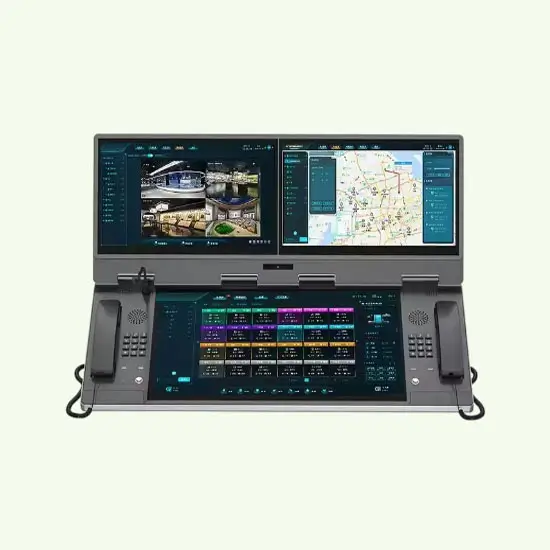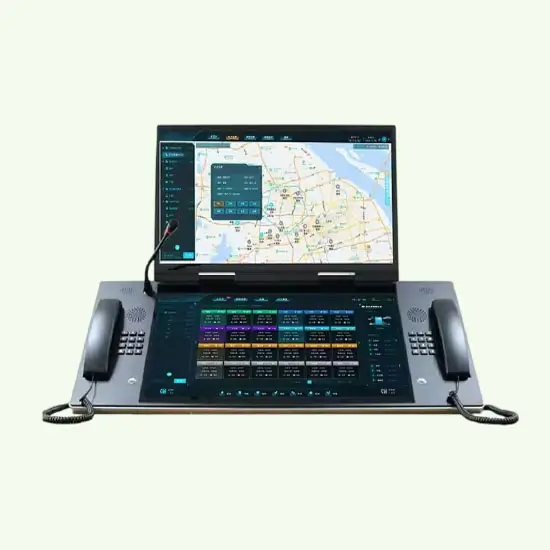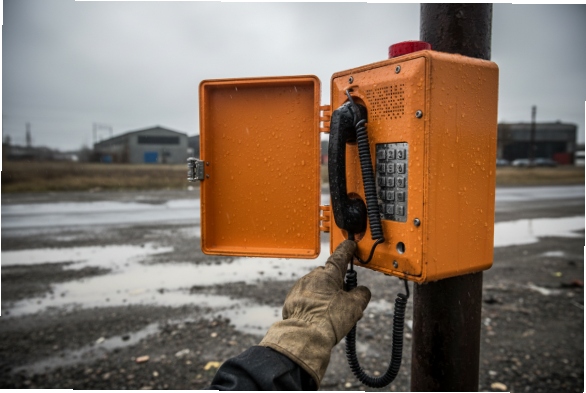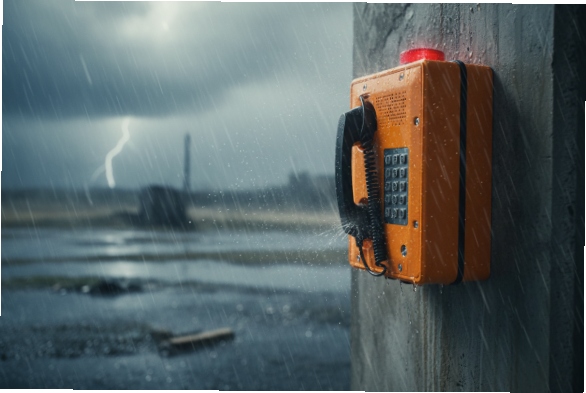
A plant can bury a distress call in seconds. When operators miss the ring, downtime and injuries rise. A horn output fixes this, but only when it is engineered right.
Yes. An explosion-proof telephone can drive an external horn through a built-in 8/16-ohm amplifier, a low-level line-out feeding a certified amplifier, a 70/100-V PA amp (via transformer), or a relay contact that triggers an external paging system.
The practical rule: the phone can output audio, but the hazardous-area path must stay compliant
Audio path options in the real world
Most “explosion-proof telephone + loudspeaker” projects fail for one reason. The team picks the audio interface 1 first, and only later checks zone rules, power, and cable loss. A better order is: define the hazard zone and distance, then pick the interface that stays safe and loud.
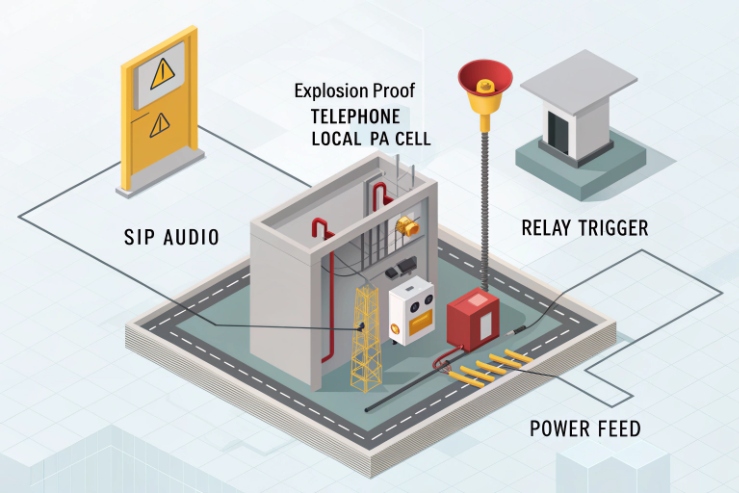
In many industrial sites, the safest design is to keep high-power audio outside the hazardous area. The explosion-proof telephone stays in the hazardous zone, but it outputs a control signal or low-level audio to a safe-area amplifier. Then the amplifier drives a horn that sits in the safe area, or a horn inside the hazardous area that has its own proper certification. If the horn must sit in the same Zone/Division as the phone, the horn itself usually needs explosion-proof certification too. High-power audio is not “intrinsically safe 2” by default.
What to verify before buying any device
- The phone must clearly state the output type: speaker output, line-out, 70/100 V, or dry contact relay.
- The system must define the alarm behavior: ring only, pre-recorded message, live paging, or both.
- The power budget must be known early: PoE limits can block a 30 W horn plan.
| Design choice | What it gives you | Typical risk | Best-fit use |
|---|---|---|---|
| 8/16-ohm amplified output | Direct horn drive (short runs) | Cable loss, power limit | Local horn near the phone |
| Line-out (low level) | Flexible, uses external amp | Needs amp location planning | Long runs, big sites |
| 70/100 V PA output (via amp) | Long cable runs, many horns | Needs matching transformers/taps | Plant-wide paging |
| Relay-triggered amplifier | Simple “alarm start” control | Relay rating, certification of control circuit | Siren/PA start, strobe + horn sync |
A simple check saves weeks: confirm the audio output spec in watts or voltage, not just “supports external speaker.”
Keep reading if you want the interface trade-offs, SPL math, and the wiring details that stop field failures.
Which interfaces enable external speakers—8/16-ohm output, 70/100 V line, line-out, or relay-triggered amplifier?
Wrong interface choices cause quiet horns, distorted audio, and failed inspections. Many teams assume every “industrial phone” has a speaker output. Many do not.
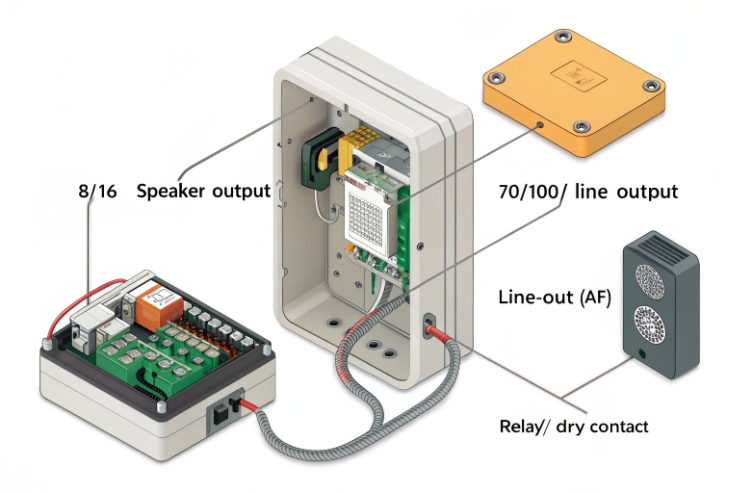
External speakers can be driven four ways: (1) direct 8/16-ohm amplified output, (2) line-out to an external amplifier, (3) 70/100-V constant-voltage via a PA amplifier, or (4) relay output that triggers an external amp or paging controller.
1) 8/16-ohm amplified output (direct drive)
This is the most direct method. The phone contains a small power amplifier. It outputs speaker-level audio for a nearby horn or cabinet speaker. It works well for short cable runs and one speaker. It becomes tricky when the horn is far away, because low-impedance 3 lines waste power as heat in the cable.
What to check:
- Rated load: 8 Ω or 16 Ω.
- Rated power: often 1–10 W on many phones, sometimes higher on special models.
- Audio behavior: ring tone only vs ring + paging + prerecorded messages.
2) Line-out (low-level audio) to an external amplifier
Line-out is usually the most flexible. The phone outputs a low-level signal (often 0.775 Vrms “0 dBu” style, or similar). An external amplifier does the heavy lifting. The amplifier can sit in a safe electrical room. This also makes it easier to add horns later.
What to check:
- Output type: balanced vs unbalanced.
- Level spec: Vrms or dBu.
- Isolation needs: ground loops are common in plants.
3) 70/100 V constant-voltage line (through a PA amplifier)
A phone rarely generates 70/100 V directly. The common design is: phone line-out → PA amplifier 4 → 70/100 V line → multiple horn speakers with transformers. This is the best fit for long runs and many horns.
4) Relay-triggered amplifier or paging controller
Many explosion-proof phones include a dry contact output. It can trigger a PA controller input, an external amplifier “remote enable,” or a siren module. This approach is reliable when the loudspeaker system is separate from the phone’s audio.
| Interface | Signal type | Pros | Cons | What to ask the supplier |
|---|---|---|---|---|
| 8/16-ohm output | Speaker-level | Simple, no extra amp | Cable loss, limited power | “How many watts into 8 Ω at what THD?” |
| Line-out | Low-level audio | Long distance, easy scaling | Needs amp and wiring discipline | “Is it balanced? What output level and impedance?” |
| 70/100 V (system) | Constant-voltage | Long runs, many speakers | Needs PA amp + transformers | “Which PA amp and horn taps match the plan?” |
| Relay trigger | Dry contact | Clean integration, inspection friendly | No audio unless PA handles it | “Contact rating and how it maps to alarm events?” |
What speaker power and SPL are supported for noisy industrial sites—15–30 W horns at 1 m?
Plants are loud. If SPL is guessed, the horn sounds strong in a quiet workshop and disappears on site. A simple SPL 5 plan avoids rework.
For noisy areas, 15–30 W horns are common, but the real target is SPL at the listener. Use the horn sensitivity (dB @ 1 W/1 m) and add 10·log10(power) to estimate output.
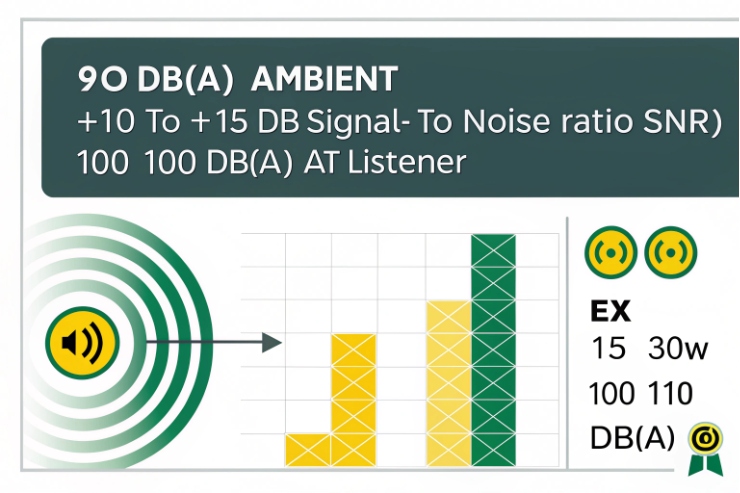
Start with the noise level and target margin
A practical rule: the alarm should be clearly above ambient noise at the ear. Many sites aim for a noticeable margin. Also, hearing safety rules can apply, so “louder” is not always “better.” The right answer depends on your site policy and local regulations.
SPL math that works in the field
Most horn datasheets state sensitivity like 108 dB @ 1 W/1 m. SPL grows with power:
- SPL ≈ Sensitivity + 10·log10(P)
Examples with a 108 dB horn:
- 15 W: 10·log10(15) ≈ 11.8 dB → ~119.8 dB @ 1 m
- 30 W: 10·log10(30) ≈ 14.8 dB → ~122.8 dB @ 1 m
Must the external horn be ATEX/IECEx or C1D1 rated with matching IP66/67 and temperature class?
Certification mistakes can stop commissioning. The horn works, but the inspector fails it. The fix often costs more than the hardware.
If the horn is installed inside a hazardous area, it must have the correct certification for that area (ATEX/IECEx Zone or North American Class/Division) and a suitable temperature class. If the horn is outside the hazardous area, standard industrial horns may be allowed.
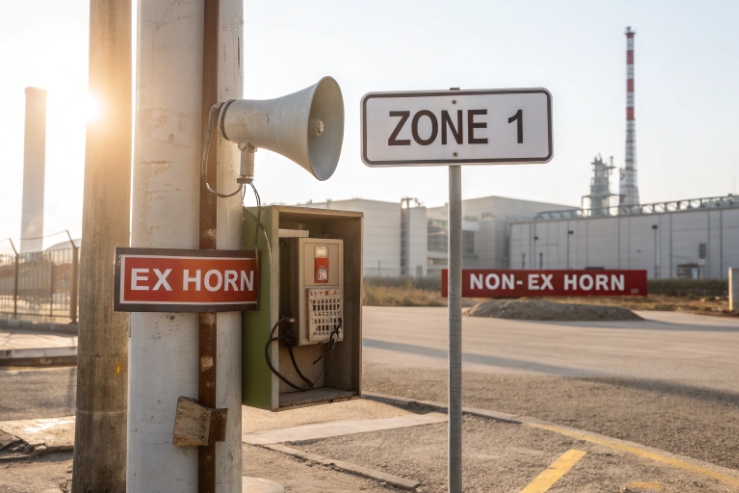
Hazardous area location decides everything
The key question is simple: Where is the horn installed?
- Horn in hazardous area → it needs hazardous-area certification that matches the site classification.
- Horn in safe area → it needs normal industrial compliance, but it still should meet IP and corrosion needs.
A phone being explosion-proof does not “cover” an uncertified horn. The horn must be ATEX/IECEx 6 certified if placed in a Zone 1 or Zone 2 environment.
How should wiring and power be designed—PoE vs 24 VDC, cable length, impedance, isolation, and surge protection?
Wiring is where good designs fail. Long runs steal power. Surges kill ports. Bad grounding adds hum. A loud system needs clean engineering.
Use PoE when the phone power budget stays within the PoE class and the horn drive is low power. Use 24 VDC (or higher system power) when you need high audio wattage, heaters, long cable runs, or stable operation during paging. Design cable size, impedance, isolation, and surge protection from day one.
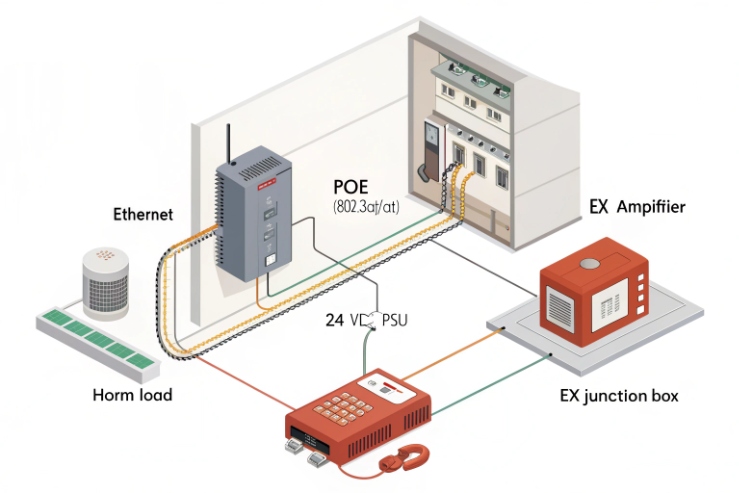
PoE vs 24 VDC: pick by power budget, not convenience
PoE 7 is clean for installation, but it has limits. If the phone must also power a strong external speaker output, extra relays, or heaters, PoE can become tight. Many networks also enforce strict PoE classes. If a device draws more than allowed, it can drop, reboot, or refuse power.
| Topic | 8/16-ohm speaker wiring | 70/100 V line wiring | Best practice |
|---|---|---|---|
| Cable length | Short is best | Long is normal | Use 70/100 V for long runs |
| Cable gauge | Thicker copper needed | Can be smaller | Size for voltage drop and heat |
| Multiple horns | Needs impedance planning | Easy with transformer taps | Sum taps, keep headroom |
| Noise immunity | Medium | High | Use shielding and good routing |
| Protection | Speaker line surge where exposed | Line surge + proper bonding | Add surge at field entry points |
Conclusion
Explosion-proof phones can drive external horns, but the right interface, correct certifications, and a solid power-and-wiring plan decide if the alarm is loud, legal, and reliable.
-
Learn the fundamentals of an audio signal interface and how it processes sound information. ↩ ↩
-
Understanding intrinsic safety design principles for preventing ignition in hazardous industrial environments. ↩ ↩
-
A technical guide to understanding electrical impedance and its impact on audio signal transmission. ↩ ↩
-
Overview of public address (PA) systems and how amplifiers distribute sound in large facilities. ↩ ↩
-
Comprehensive definition of sound pressure level (SPL) and its measurement in decibels. ↩ ↩
-
Official resources for international explosion-proof certification standards used in hazardous locations worldwide. ↩ ↩
-
Technical standards for Power over Ethernet (PoE) technology in enterprise and industrial networks. ↩ ↩