

When alarms fail to trigger, people do not move. In hazardous areas, that gap turns into shutdowns, audits, and safety risk.
Yes. An explosion-proof telephone can integrate with audible-visual beacons using relay/dry contacts, SIP events, or IP APIs. The correct method depends on your area classification, power budget, fail-safe rules, and how you manage priorities with PAGA, fire panels, and SCADA.
Integrating beacons with Ex phones without breaking compliance?
Think in “cause-and-effect,” not only wiring
A beacon is part of a safety function. So the first step is a simple cause-and-effect list:
- What triggers the beacon (SOS button, incoming priority call, paging, loss of network, loss of power)?
- What must happen next (flash + sound, flash only, sound only, reset rules)?
- Who can acknowledge and silence it (local button, remote dispatcher, SCADA/HMI)?
- What is the fail mode (beacon ON by default, or OFF by default)?
This list matters because different trigger technologies behave differently. A dry contact 1 is simple and fast, but it does not carry “why.” An IP API can carry context, but it relies on network health.
Use one of three proven architectures
1) Phone triggers beacon directly (relay / dry contact)
- Best for fast local warning near the call point.
- Easy to inspect and maintain.
- Needs correct power design for inrush and relay life.
2) Phone triggers a controller (PAGA / fire panel / I/O module), controller drives beacon
- Best when you need priorities, zoning, and supervised circuits.
- The controller owns the alarm logic and acknowledgments.
3) Phone publishes an event over IP (SIP/HTTP/MQTT), platform drives beacon
- Best for modern centralized platforms and multi-site monitoring.
- Needs strong cybersecurity and a defined offline behavior for SIP events 2.
Write it into tenders as a system interface, not a vague feature
| Requirement item | What to state | Why it prevents disputes |
|---|---|---|
| Trigger method | Relay output / SIP event / HTTP API / Modbus gateway | Avoids “we assumed it” failures |
| Output rating | Contact rating, max inrush, load type | Stops welded contacts and brownouts |
| Area compliance | Beacon certification and T-class match | Keeps inspection clean |
| Acknowledgment | Local + remote reset method | Avoids alarms that never clear |
| Fail-safe | Alarm on fault or alarm off on fault | Aligns with site safety philosophy |
A short pilot test should always be planned. One phone, one beacon, one controller path, and a real noise and vibration condition. That pilot saves weeks later.
Which interfaces trigger beacons—relay outputs, dry contacts, SIP events, HTTP/MQTT APIs, or Modbus I/O?
Bad interface choices create hidden downtime. A beacon that depends on the wrong network path can fail exactly during a network fault.
The most common and reliable trigger is a relay/dry contact from the phone to a beacon driver or panel input. SIP SUBSCRIBE/NOTIFY events can also drive alarms in PBX platforms, while HTTP/MQTT and Modbus are best when you already run an OT/IoT event layer.
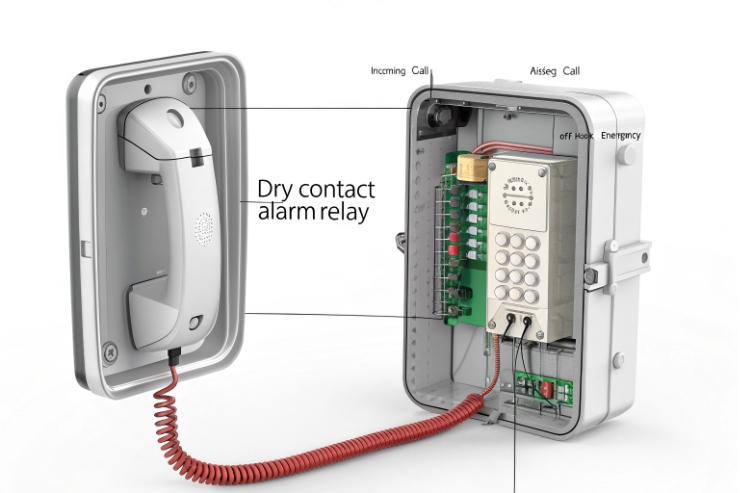
Relay outputs and dry contacts
Many industrial Ex phones include one or more relay outputs. These are usually “dry contacts” (no voltage provided). The phone changes the contact state, and your external circuit supplies power to the beacon driver coil or input module. This is simple and predictable.
Key details to specify:
- NO/NC contact type and default state on power loss
- contact rating (voltage, current, and load category)
- whether the phone supports pulse, latch, and timed outputs
- whether there is an input contact for “acknowledge” or “door/alarm feedback”
SIP events and PBX-driven logic
If the phone and platform support SIP event notifications, the platform can trigger an alarm workflow when specific states occur (call start, hotline, panic key, registration loss). SIP SUBSCRIBE/NOTIFY is defined as a general framework, then vendors build event packages on top. This is useful when alarms must be routed, logged, and prioritized across many sites.
HTTP, MQTT, and Modbus as “integration layers”
Some sites want alarm events to flow into SCADA or an IoT broker. HTTP callbacks and MQTT 3 publish/subscribe work well for this style. MQTT is standardized and commonly used in OT/IoT messaging. Modbus usually appears when you integrate through a relay I/O module, because many plants already have Modbus masters in PLC/SCADA.
| Interface | Strength | Weak point | Best use |
|---|---|---|---|
| Relay / dry contact | fast, simple, inspectable | limited context | local beacon near phone |
| SIP event | rich state + logs | depends on PBX/SBC logic | enterprise alarm workflows |
| HTTP API | easy integration | security and retries matter | platform or NVR triggers |
| MQTT | scalable pub/sub | needs broker + policy | OT dashboards and analytics |
| Modbus I/O | OT-friendly | extra hardware | PLC/SCADA cause-and-effect |
Are Ex-rated beacons required—ATEX/IECEx or C1D1/C1D2—with matching voltage, current, and temperature class?
A beacon can be “industrial” and still be illegal in the hazardous zone. Then the whole system fails inspection, even if the phone is correctly certified.
Yes. In Zone 1/2 or Class/Division areas, the beacon itself must be certified for that hazardous location scheme and must match gas group, temperature class (T-rating), ambient range, and electrical ratings.
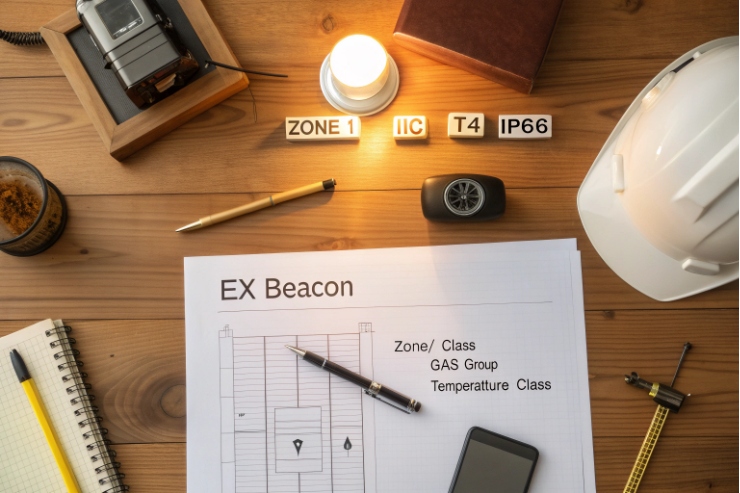
Match the site classification scheme
Many regions use ATEX/IECEx 4 Zone marking. North America often uses NEC Class/Division (or Class/Zone in some designs). The beacon must match the scheme used by the installation code and by the site documentation. Mixing “worlds” without a clear code basis creates approval delays.
Temperature class is not optional
Your alarm device can become a hot surface. Temperature class (T1–T6) defines maximum surface temperature limits. If your site requires T4, then the beacon must be rated T4 or better (T5/T6 are “cooler” devices). This is critical when you choose high-power sounders, strobes, or combined units.
How should wiring and power be designed—PoE vs 24 VDC, inrush current, isolation, and fail-safe activation?
Many beacon failures are not product failures. They are wiring failures: inrush trips, contact welding, or ground faults that were never planned.
Use PoE to power the telephone and use a separate, correctly fused 24 VDC (or site standard) supply for beacons unless the phone is explicitly designed to power external loads. Design for inrush, use isolation, and define fail-safe contact states.
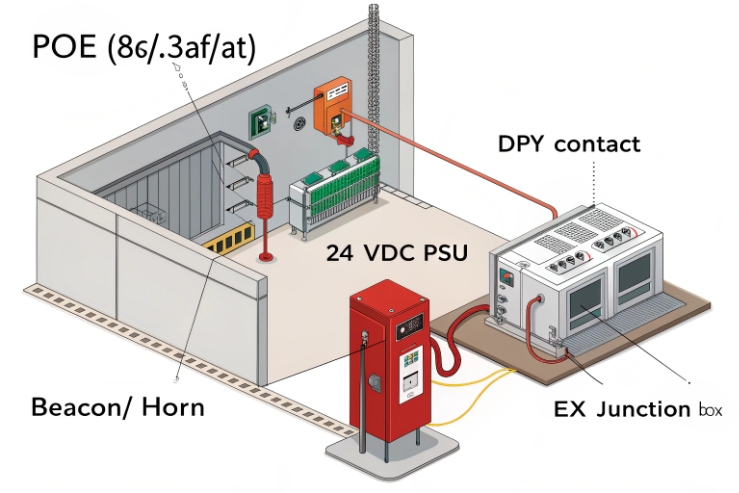
PoE is usually for the phone, not for the beacon load
PoE 5 budgets are great for phones and small accessories. Audible-visual beacons often draw more current, especially at startup, than a phone relay output should carry. So the normal design is:
- PoE → Ex phone
- 24 VDC (or AC) → beacon driver circuit
- phone relay → controls the driver circuit (or panel input)
Design for inrush and inductive loads
Strobes and sounders can have high inrush. Relays driving coils create inductive kick. These two facts drive most field failures.
Can alarm logic integrate with PAGA, fire panels, SCADA/DCS, or NVRs for priorities and acknowledgments?
Without a logic owner, alarms overlap and nobody knows what to silence first. That creates confusion during a real incident.
Yes. The phone can trigger beacon logic through relay I/O into PAGA/fire panels or through IP events into SCADA/NVR platforms. The safest approach is a single priority owner (often PAGA or fire) with clear acknowledgments and event logging.
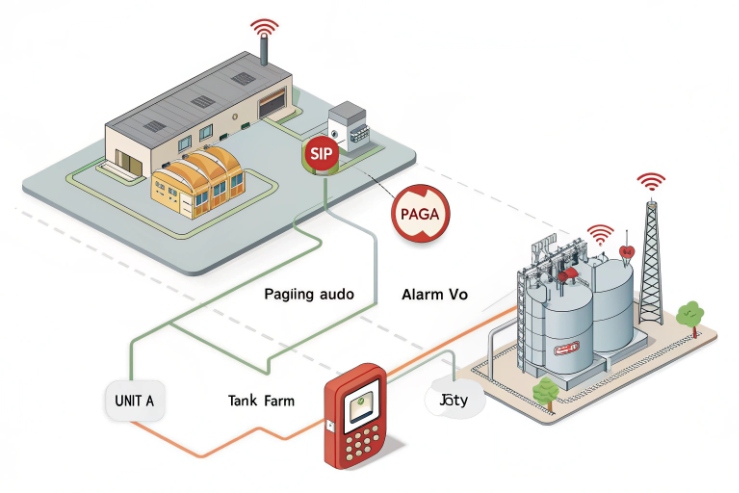
Integration patterns that work in real plants
1) Phone → PAGA 6 (priority owner) → beacon zones
- SOS button calls dispatcher and activates a local zone beacon.
- PAGA applies priorities, timers, and resets.
- Acknowledge can be local (button) and remote (control room).
2) Phone → fire panel input (supervised)
- Useful when the phone is part of emergency call points tied to evacuation logic.
- Fire panels often need supervised circuits (EOL resistors, fault monitoring).
3) Phone → SCADA 7/DCS via I/O or gateway
- The phone provides a contact closure or IP event.
- SCADA logs the event and can require operator acknowledgment.
- SCADA can also inhibit alarms during maintenance windows.
| Platform | Typical trigger | Typical acknowledgment |
|---|---|---|
| PAGA | dry contact / SIP trigger | operator console + local reset |
| Fire panel | supervised input | panel reset procedure |
| SCADA/DCS | Modbus I/O or MQTT/HTTP | HMI acknowledge + audit log |
| NVR | HTTP event / platform rule | security console action |
Conclusion
Yes. Ex telephones can drive audible-visual beacons. Choose the trigger path, match hazardous certifications and T-class, design power for inrush and fail-safe behavior, and centralize priorities in PAGA/fire/SCADA logic.
⸻
Footnotes
-
Learn about dry contacts and how they provide electrically isolated switching for industrial alarm systems and control interfaces. ↩
-
A guide to SIP specific event notification framework used for real-time monitoring of IP telecommunication device states. ↩
-
Official site for MQTT, the standard messaging protocol for industrial Internet of Things and machine-to-machine communication. ↩
-
Access the official IECEx portal for information on international certification schemes for equipment used in explosive atmospheres. ↩
-
Understanding Power over Ethernet technology which enables network cables to carry electrical power to industrial IP endpoints. ↩
-
Comprehensive overview of Public Address and General Alarm systems used for critical safety communication in industrial plants. ↩
-
Technical resources on Supervisory Control and Data Acquisition systems for monitoring and controlling large-scale industrial processes. ↩








