
Many projects ask for “Ex phone” and assume every design is the same. That mistake can cause a failed inspection or a phone that cannot deliver enough power for real use.
Yes, an explosion-proof telephone can be designed as intrinsically safe (Ex i), but it is usually a low-power design. For higher audio power, PoE, heaters, or relay loads, Ex d or Ex e designs are often more practical.

How Ex i fits into explosion-proof telephone design
Ex i is a “low energy” protection concept, not a marketing label
intrinsically safe (Ex i) 1 design limits electrical energy so sparks and hot surfaces cannot ignite hazardous atmospheres, even during faults. This is why Ex i is popular for instrumentation loops and handheld devices. The tradeoff is simple: available voltage, current, and power are restricted, so features that need higher power become harder or impossible to deliver.
For telephones, that power tradeoff touches real user experience:
- speaker volume and clarity in noisy plants
- keypad backlight brightness
- heaters for cold climates
- relay outputs for beacons or sirens
- PoE power budgets and long cable runs
So the first decision is not “Ex i or not.” The first decision is: what functions must work at full strength in the hazardous area.
Many real deployments use mixed concepts
A common pattern is a robust enclosure concept (Ex d or Ex e 2) for the main phone, while some external circuits are made intrinsically safe through isolators. This is often seen as markings that include intrinsic safety in brackets for associated apparatus and combinations of protection concepts. The goal is to keep the phone powerful and durable while keeping sensitive I/O safe and easy to integrate.
A quick “fit test” before writing the tender
| Requirement | Ex i is usually a good fit | Ex d / Ex e is usually a better fit |
|---|---|---|
| Simple emergency calling | Yes | Yes |
| Very loud audio and paging | Hard | Easier |
| PoE-powered phone | Rare | Common |
| Multiple relay outputs | Hard | Easier |
| Minimal maintenance and simple cabling | Often yes | Depends on glands and conduit |
| Integration with plant I/O via barriers | Yes | Yes |
When the target is Zone 1 refinery use with strong audio, PoE, and beacon control, many teams end up with Ex d or Ex e for the phone, and Ex i only for specific external signals.
Which Ex i levels apply—Ex ia/ib/ic—and which hazardous zones allow intrinsically safe telephones?
Teams often mix up “Zone” and “level of protection.” That confusion leads to buying the wrong marking for the area classification.
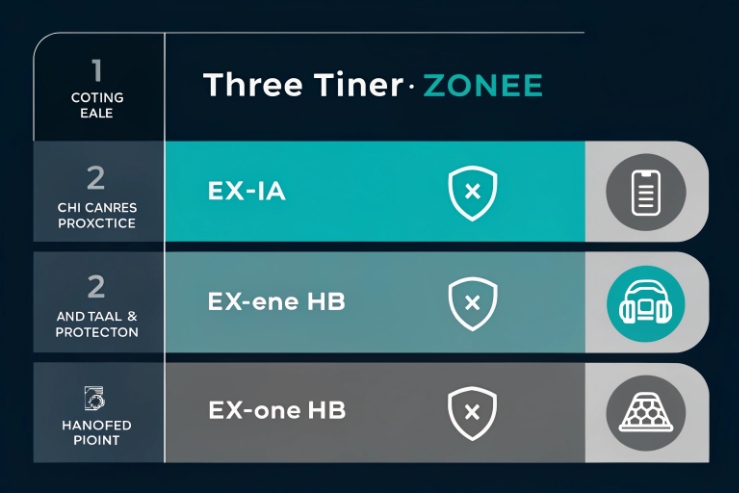
Ex ia is typically used for the highest risk areas (including Zone 0 gas), Ex ib for Zone 1 gas, and Ex ic for Zone 2 gas. For dust, the same concept maps to EPL Da/Db/Dc and Zones 20/21/22.
Ex i levels and where they are normally permitted
In the IEC Zone system for gas:
- Ex ia (EPL Ga) is intended for Zone 0 (continuous hazard) and can also be used in Zones 1 and 2.
- Ex ib (EPL Gb) is intended for Zone 1 (hazard likely in normal operation) and can also be used in Zone 2.
- Ex ic (EPL Gc) is intended for Zone 2 (hazard not likely and short duration).
For dust, similar logic is used with Equipment Protection Level 3 (EPL) markings and Zones 20/21/22. Higher protection levels can be used in lower-risk zones, but not vice-versa.
When is Ex d or Ex e preferred over Ex i because of audio power, PoE, or relay outputs?
Many buyers like Ex i because it feels simpler. Then the feature list grows. At that point, Ex i becomes the bottleneck.
Ex d or Ex e is often preferred when the telephone needs high audio output, PoE power, heaters, bright backlighting, or relay outputs that switch real loads. Ex i is best when the phone can stay low-power and energy-limited by design.
PoE is the clearest dividing line
Standard PoE power levels are far above what most intrinsically safe circuits allow. A typical SIP phone on PoE can draw enough power for loud audio, LEDs, and sometimes extra modules. Intrinsic safety, by nature, restricts available energy. This is why intrinsically safe Ethernet solutions talk about milliwatt-level power in the highest risk zones, while PoE is measured in tens of watts.
Can handsets, keypads, or I/O be Ex i using barriers/isolators, and how are entity parameters (Uo/Io/Po, Co/Lo) verified?
A common myth is that any device becomes intrinsically safe after adding a barrier. That is not how Ex i works.
Some circuits like external switches, handset paths, or low-energy I/O can be made Ex i using barriers or galvanic isolators, but the device and the system must be verified using entity parameters. Verification checks Uo/Io/Po against Ui/Ii/Pi and confirms cable capacitance/inductance stays within Co/Lo limits.
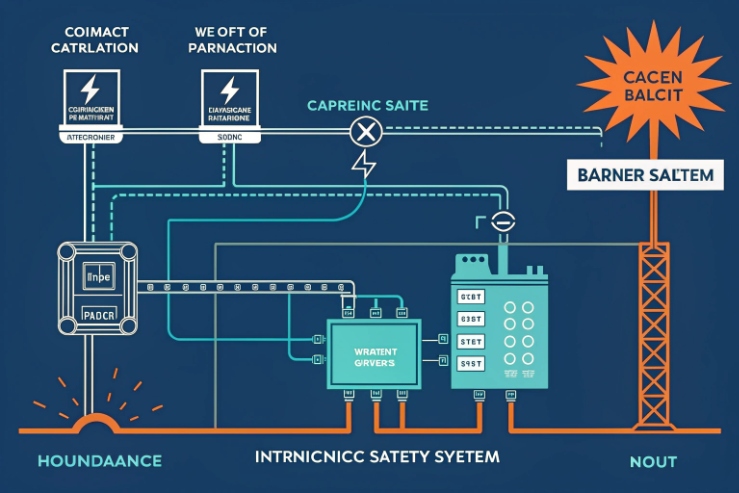
Associated apparatus and entity parameters
Associated apparatus 4, such as Zener barriers or galvanic isolators, are installed in safe areas to limit energy into hazardous zones.
Entity verification is the backbone of Ex i system acceptance. It requires checking entity parameters 5 to ensure the source and device match safely.
| Parameter | From associated apparatus | From field device | Pass rule |
|---|---|---|---|
| Voltage | Uo / Voc | Ui / Vmax | Uo ≤ Ui |
| Current | Io / Isc | Ii / Imax | Io ≤ Ii |
| Power | Po | Pi | Po ≤ Pi |
What documentation proves compliance—ATEX/IECEx certificates, control drawings, cable L/C limits, and IEC 60079-14 installation rules?
A phone can be technically safe and still fail acceptance if paperwork is weak. Inspectors need traceable evidence, not only a label photo.
Compliance is proven with the correct certificates for the equipment and protection concept, plus control drawings for intrinsically safe loops, cable capacitance/inductance limits, and installation evidence aligned with IEC 60079-14.
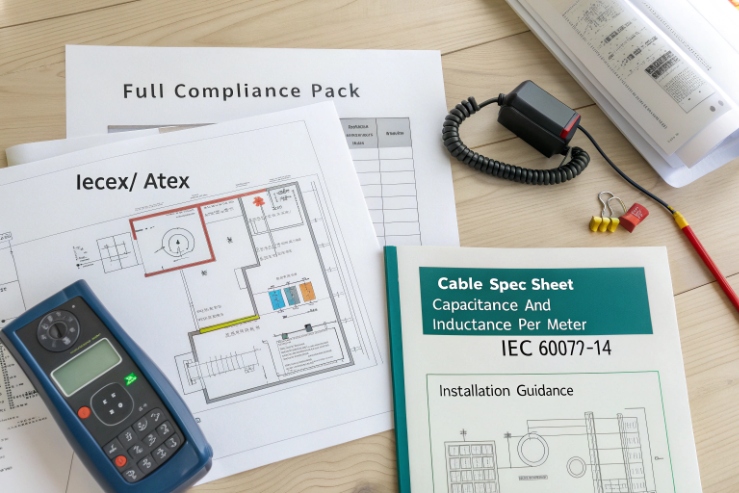
Verification and Certification
For ATEX/IECEx 6 compliance, the certificate must match the protection concept and temperature class of the site.
Furthermore, IEC 60079-14 7 governs selection and installation practices in explosive atmospheres, ensuring earthing and wiring separation rules are correctly followed.
Conclusion
Yes, Ex i telephones are possible, but power limits shape features and wiring. For loud PoE phones, Ex d/Ex e is often better. For support, contact info@sipintercommanufacturer.com.
Footnotes
-
Understanding the primary safety concept used to prevent ignition by limiting energy in hazardous location equipment. ↩ ↩
-
An overview of flameproof and increased safety protection concepts for electrical equipment in explosive atmospheres. ↩ ↩
-
This guide explains Equipment Protection Levels which classify the inherent ignition risk of electrical devices in various zones. ↩ ↩
-
Essential information on barriers and isolators used to create a safe interface between hazardous and safe areas. ↩ ↩
-
Learn how entity parameters define electrical compatibility limits for intrinsically safe circuits and associated cabling. ↩ ↩
-
Official portal for global certification schemes regarding equipment used in potentially explosive atmospheres. ↩ ↩
-
The international standard detailing requirements for the design, selection, and installation of electrical systems in hazardous areas. ↩ ↩