

Random VLAN mistakes and QoS gaps can turn a “working” Ex phone into a noisy, unreliable endpoint. In hazardous plants, every rollback costs time and permits.
Yes. Many explosion-proof SIP telephones can support LLDP, and some also support LLDP-MED to auto-learn voice VLAN and QoS policies, share inventory/location data, and improve PoE behavior—if the switch and the phone are configured to exchange the right TLVs.

A clear LLDP/LLDP-MED checklist for hazardous-area SIP phones
LLDP vs LLDP-MED in one minute
LLDP is a neighbor discovery protocol 1. It lets a phone and a switch advertise basic identity and capabilities using TLVs (type-length-value fields). LLDP-MED is an extension designed for “media endpoint devices,” so VoIP endpoints can learn voice VLAN 2 and QoS settings from the access switch, and so the switch can learn useful endpoint info (inventory and location).
From a deployment view, LLDP is the baseline “who are you” channel. LLDP-MED is the “how should I behave on the edge” channel.
Why this matters more for Ex phones than office phones
Explosion-proof telephones are often installed in places where:
- the cable path is long and changes hands across contractors
- VLAN separation is strict (IT/OT, safety, paging, CCTV)
- switches may be industrial-grade and heavily locked down
- maintenance windows are rare, and a wrong VLAN can delay a permit-controlled task
So the value of LLDP-MED is not just convenience. It reduces commissioning time and reduces repeated site visits.
Minimum feature set that makes LLDP-MED worth enabling
A practical baseline for Ex SIP phones is:
| Feature | LLDP (802.1AB) | LLDP-MED (TIA-1057) | Why it matters in plants |
|---|---|---|---|
| Neighbor discovery | ✅ | ✅ | Find the right switchport fast |
| Voice VLAN assignment | ⚪ | ✅ | Plug-and-play voice VLAN |
| QoS policy (CoS/DSCP) | ⚪ | ✅ | Stable voice quality under load |
| Inventory (model/serial) | ⚪ | ✅ | Faster asset tracking and spares |
| Location identification | ⚪ | ✅ | Helps emergency response and mapping |
| Power info / PoE hints | ⚪ | ✅ (varies by vendor) | Better PoE behavior and priority handling |
Which LLDP-MED features are available—voice VLAN, QoS/DSCP, PoE power negotiation, and location identification?
Miss one edge feature and the phone still “registers,” but calls sound bad or endpoints land in the wrong VLAN. That creates hidden operational risk.
Most LLDP-MED deployments focus on Network Policy (voice VLAN + QoS/DSCP), plus Location and Inventory TLVs. PoE negotiation is mainly handled by Ethernet/PoE standards, but LLDP-MED can help with power reporting and priority behavior depending on the switch and phone.
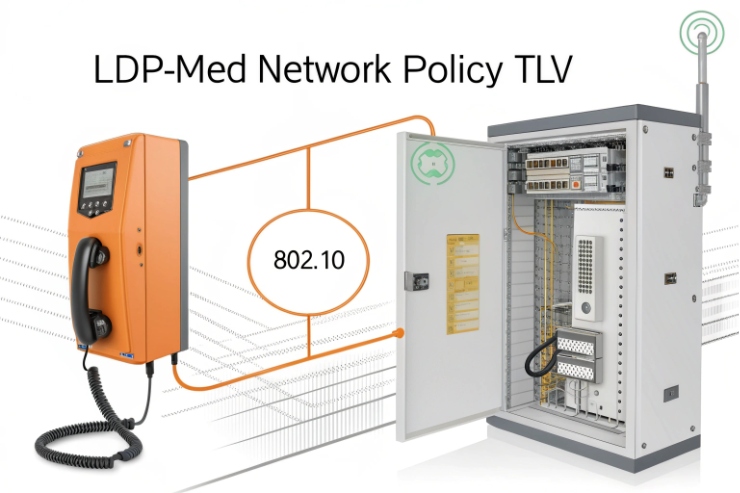
Network Policy TLV: voice VLAN + QoS in one push
The most valuable LLDP-MED function is the Network Policy TLV 3. It lets the switch advertise:
- VLAN ID (voice VLAN)
- tagging mode
- Layer-2 priority (CoS)
- Layer-3 marking targets (DSCP)
Location TLV: useful when the phone is part of emergency response
LLDP-MED can carry location information in formats such as civic address and coordinates. In practice, many sites use this for plant area mapping and dispatch for tunnel phones.
PoE: what LLDP-MED does and does not do
A clear rule prevents confusion:
- PoE power delivery is negotiated by PoE mechanisms (hardware level).
- LLDP/LLDP-MED can supplement power info and priority handling, depending on platform.
| LLDP-MED feature | What it configures | Plant value | Common pitfall |
|---|---|---|---|
| Voice VLAN | VLAN ID + tagging | correct segmentation | mixed data/voice VLAN causes paging failures |
| QoS (CoS/DSCP) | marking targets | stable voice | QoS/DSCP 4 mismatch across core |
| Location | civic/coords | emergency mapping | location database not maintained |
| Inventory | model/serial/sw | asset control | endpoint does not send inventory by default |
Are LLDP TLVs compatible with Cisco, HPE/Aruba, Huawei, and industrial switches from Hirschmann/Moxa?
Multi-vendor sites often fear “it only works with brand X.” That fear is valid when the configuration relies on proprietary discovery, not open TLVs.
LLDP is vendor-neutral by design, and LLDP-MED is a standards-based extension. Cisco, HPE/Aruba, and Huawei commonly support LLDP-MED functions. Many industrial switches support LLDP, but you should confirm the exact model and firmware.
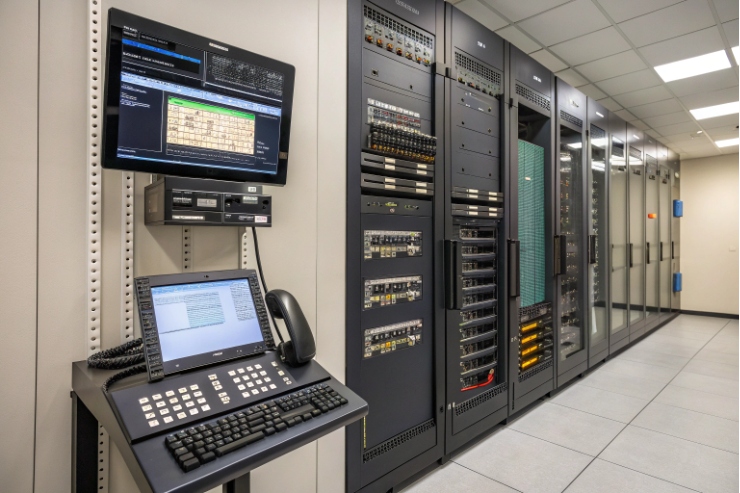
Industrial switches: LLDP is common, LLDP-MED varies
Industrial switches often support LLDP because it is used for topology and diagnostics. LLDP-MED is more mixed. Some industrial platforms explicitly include LLDP-MED voice VLAN options, while others focus on standard LLDP plus industrial profiles.
Can LLDP be enabled, prioritized, and monitored via web UI, auto-provisioning, or SNMP?
Many plants want “plug and play,” but they also want control. LLDP that cannot be monitored turns into a blind spot during incidents.
Yes. LLDP/LLDP-MED is typically configurable via the phone’s web UI and can be pushed by auto-provisioning. Monitoring is commonly done through switch neighbor tables and SNMP (LLDP-MIB).
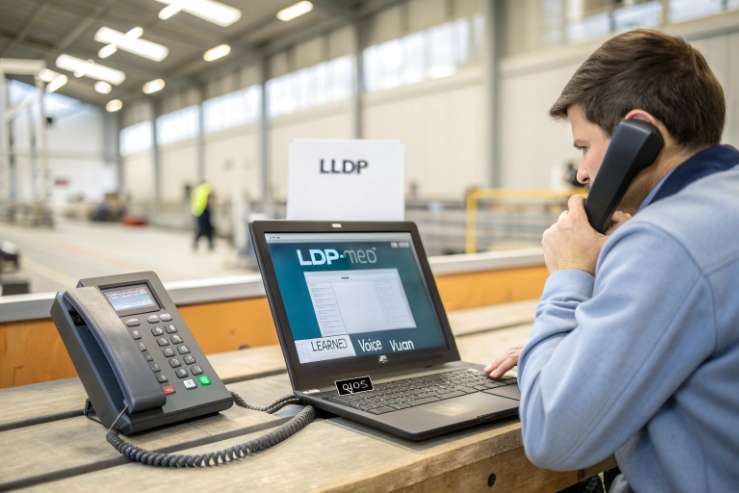
Provisioning: keep LLDP settings consistent
If an Ex phone supports auto-provisioning, LLDP can be treated as a baseline parameter set to ensure correct SIP server and feature alignment across hundreds of devices.
How does LLDP-MED improve plug-and-play deployment alongside 802.1X, DHCP options, and multicast paging?
A phone that needs manual VLAN and QoS config is slow to deploy and easy to misconfigure. In plants, that creates uneven call quality and paging failures.
LLDP-MED enables “edge intent” to be pushed from the switch: voice VLAN and QoS arrive automatically at link-up. When combined with 802.1X policies, DHCP options, and correct multicast configuration, it reduces truck rolls and keeps workflows consistent.
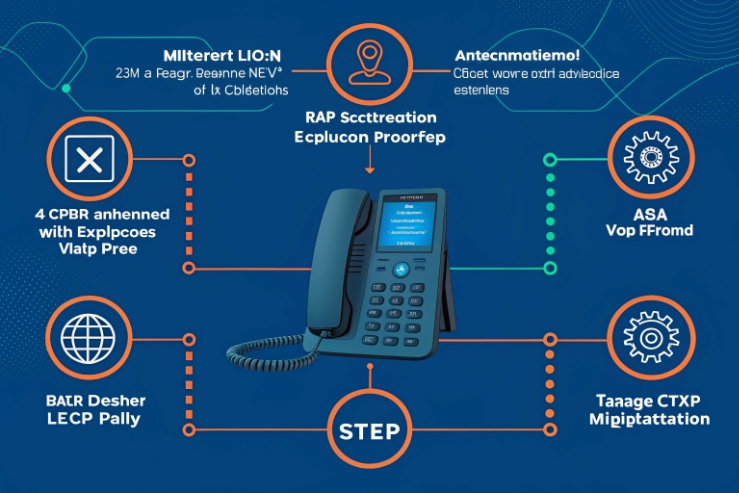
LLDP-MED + 802.1X: keep the workflow predictable
802.1X policies 5 control who can join the network. LLDP-MED then controls how the phone tags and marks traffic once it joins.
DHCP options: the fallback and the bootstrap
DHCP options 6 remain useful to tell the phone where provisioning lives or provide a fallback voice VLAN when MED is not available.
Multicast paging: why VLAN + QoS automation matters
Multicast paging 7 is common in industrial SIP deployments. LLDP-MED helps because endpoints start in the right VLAN with the right QoS marking, reducing paging failures.
| Step | What happens | Tool | Result |
|---|---|---|---|
| 1 | Port comes up | LLDP fast-start | phone learns edge policy quickly |
| 2 | Phone authenticates | 802.1X or MAB | port role applied |
| 3 | Phone gets policy | LLDP-MED Network Policy | voice VLAN + QoS set automatically |
| 4 | Phone gets config | DHCP option + provisioning | correct SIP server and features |
| 5 | Paging works | VLAN + IGMP + QoS aligned | consistent multicast behavior |
Conclusion
LLDP is common, and LLDP-MED is a strong edge tool for voice VLAN and QoS when switches support the right TLVs. For OEM guidance, email info@sipintercommanufacturer.com.
⸻
Footnotes
-
An open-standard layer 2 protocol used by network devices for advertising their identity and capabilities. ↩ ↩
-
A specialized VLAN feature that prioritizes voice traffic and automatically separates it from data traffic. ↩ ↩
-
An LLDP-MED extension that allows switches to send VLAN and priority settings directly to connected IP phones. ↩ ↩
-
DSCP is a networking architecture that classifies and manages network traffic to provide quality of service. ↩ ↩
-
A port-based network access control standard providing an authentication mechanism to devices wishing to join a LAN. ↩ ↩
-
Configuration parameters and other control information carried in the DHCP protocol to automate device network setup. ↩ ↩
-
A method of sending IP packets to a group of interested receivers in a single transmission. ↩ ↩








