

ESD can reset or kill an Ex telephone in one touch. In hazardous areas, that means lost calls and audits. A clear ESD target prevents both.
For most outdoor Zone 1/2 telephones, specify IEC 61000-4-2 Level 4 immunity: ±8 kV contact and ±15 kV air, with performance criterion A or B defined by your product standard. Then support it with Ex-safe bonding and antistatic design choices.
Set an ESD immunity target that matches Ex reality
ESD immunity is a “system” requirement, not a single kV number
An explosion-proof telephone usually fails ESD in two ways. First, the user touches the keypad, handset, or metal bezel, and the discharge couples into audio, the Ethernet PHY, or the CPU reset line. Second, the discharge lands nearby and couples into the cable shield, the gland plate, or a bracket, then sneaks into the electronics through impedance in the bonding path. Both happen even when the phone has a strong Ex certificate, because Ex certification is about ignition protection, not EMC robustness.
A practical tender separates:
- ESD immunity test level (what the phone must survive)
- Performance criterion (what “pass” means operationally)
- Installation assumptions (bonding, shielding, glands, IP sealing)
What “pass” should mean for an emergency device
For a hazardous-area emergency telephone, ESD should not create hidden failures. A good pass definition includes:
- no permanent damage
- no unsafe behavior (stuck relay, continuous ring, false alarm)
- no loss of registration that requires a truck roll
- fast self-recovery if a reset is allowed
A simple target matrix that helps procurement
| Site use case | Recommended ESD target | Performance expectation | Notes to add in the tender |
|---|---|---|---|
| Indoor hazardous area, controlled handling | IEC 61000-4-2 Level 3 | A preferred, B acceptable | Keep metalwork bonded, avoid floating panels |
| Outdoor Zone 1/2, normal industrial handling | IEC 61000-4-2 Level 4 | A or B | Include indirect discharges to coupling planes |
| Offshore / mining / frequent glove contact | Level 4 + “Level X” option if justified | A preferred | Add “as-installed” bonding and shield termination checks |
How to write the ESD requirement so it is testable
A solid line item looks like this:
- ESD immunity per IEC 61000-4-2 electrostatic discharge immunity test method 1, contact and air discharges at defined points the user can touch
- indirect discharges to coupling planes
- defined functional checks during and after testing (call setup, audio, key actions, relay I/O, SIP registration)
- defined performance criterion A/B for each function
This is where many projects save money. A clear ESD target reduces returns, reduces site downtime, and makes vendor comparisons fair.
Keep reading, because the next part decides which standards and “A/B” wording should appear in your spec.
The standard language is where most tenders become either clear or messy.
Which standards define ESD tests—IEC 61000-4-2 levels and performance criteria A/B?
Many datasheets say “ESD: 15 kV” without stating the standard, the method, or the pass criterion. That line is easy to argue about later.
Use IEC 61000-4-2 to define ESD test method and levels. Define performance criteria A/B in your product standard or procurement spec so suppliers cannot choose a weaker pass definition.
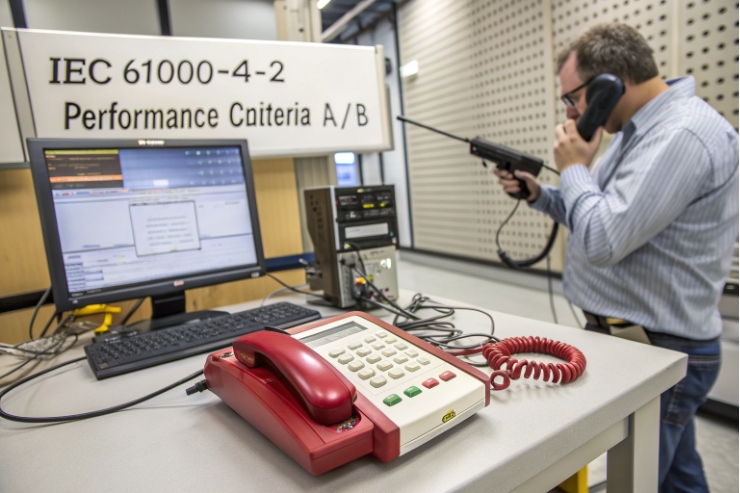
IEC 61000-4-2 is the core reference for equipment ESD immunity
IEC 61000-4-2 sets the test approach most buyers expect:
- contact discharge (preferred where possible)
- air discharge (used where contact cannot be applied, such as insulated surfaces)
- direct discharges to accessible points
- indirect discharges through coupling planes (a common cause of real resets)
This is important for explosion-proof telephones because the phone is touched by people in PPE. That means direct discharges to user surfaces must be included, not only discharges to a connector hidden inside the housing.
What “Performance criterion A/B” should mean in your tender
Different product families interpret criteria through their own standards, but the usual procurement meaning is:
- Criterion A: the phone operates normally during and after the test (no user-visible impact).
- Criterion B: temporary degradation is allowed during the test, but the phone self-recovers after the event without damage or manual intervention.
If you want a clean “industrial immunity” reference point for defining criteria language, align your tender wording to the style used in IEC 61000-6-2 industrial EMC immunity (generic) standard 2.
For emergency use, criterion A is the clean target. Criterion B can be acceptable if the phone automatically returns to service fast and does not lose configuration, registration, or alarm logic.
Don’t forget the lab condition limits
IEC 61000-4-2 also controls lab conditions, especially for air discharge tests. If the test is performed outside the normal temperature and humidity window, results become harder to compare across suppliers. When a vendor provides a report, it should show test environmental conditions clearly.
A tender-ready table for standards wording
| Spec item | Recommended wording | Why it prevents weak claims |
|---|---|---|
| Standard | “ESD immunity per IEC 61000-4-2” | Locks test method and setup |
| Levels | “Test to Level 4 unless project defines Level X” | Prevents under-testing |
| Pass criterion | “Performance criterion A for call/audio; B acceptable for UI only” | Protects emergency function |
| Test points | “All user-accessible metal and keypad/handset surfaces” | Matches real handling |
| Evidence | “Provide full test report with points list and results” | Stops one-line datasheet claims |
Once the standards language is clear, the next question becomes simple: what kV levels are typical in harsh outdoor hazardous sites.
What kV levels are typical—±8 kV contact and ±15 kV air for hazardous outdoor sites?
Outdoor sites can look wet and safe, then winter arrives and static returns. One discharge can reset a phone during a critical call.
Level 4 values are the most common procurement target for harsh environments: ±8 kV contact and ±15 kV air under IEC 61000-4-2. Higher “Level X” values are used only when risk justifies it and design proof is provided.
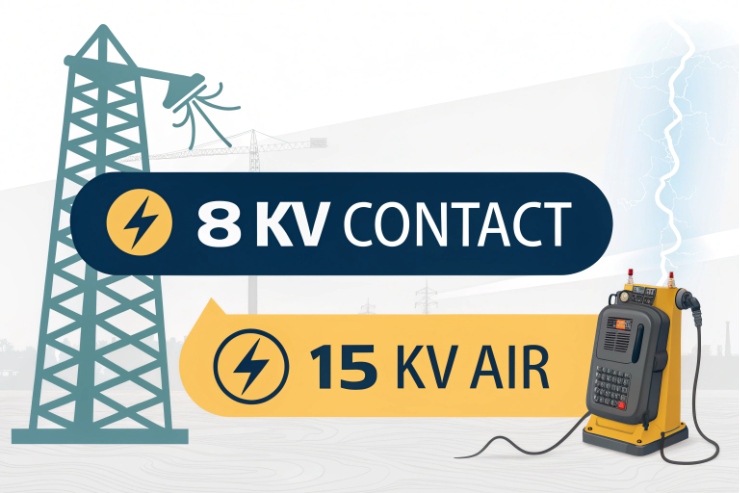
Why Level 4 is the practical baseline
Level 4 is often chosen because it aligns with heavy industrial handling and gives a safety margin for unknown user behavior. On hazardous area telephones, the user may wear gloves and move fast. The phone may be mounted on a painted steel structure with imperfect bonding. In that mix, Level 4 is a sensible baseline.
That said, “15 kV air” does not mean the phone will never reset. Air discharge is less repeatable than contact discharge. A robust design focuses on contact discharge performance on conductive touch points, then uses air discharge for insulating surfaces where contact testing cannot be applied.
When “Level X” makes sense
Some customers ask for 20–30 kV ESD ratings because semiconductor datasheets show big numbers. Those are often component ratings, not full system tests. “Level X” can be valid in these cases:
- extremely dry climate and frequent operator contact
- plastic user interfaces where air discharge dominates
- high-value downtime sites where extra margin pays back fast
When “Level X” is requested, the tender should also require:
- the exact waveform standard (still IEC 61000-4-2)
- repeat count and test points
- performance criteria defined per function
Include indirect discharges or the test misses real failures
Many “field resets” come from indirect coupling into cable shields and chassis. So the tender should include:
- discharges to coupling planes
- discharges to mounting bracket zones and gland plates (when accessible)
- verification of SIP registration stability after the test
A simple “typical levels” guide that clients understand
| Environment reality | Typical ask | What to clarify |
|---|---|---|
| Normal industrial indoor | Level 3 | Contact points list |
| Outdoor industrial | Level 4 | IP sealing must remain intact |
| Offshore / mines with long metal structures | Level 4 + strong bonding rules | Shield termination and lug quality |
| Special dry climate | Level 4 + “X” if needed | Require test report, not marketing |
Next is the part many buyers overlook: enclosure and gasket design. In ATEX/IECEx areas, the materials and bonding choices also tie into electrostatic hazard control.
How do enclosure materials, gasket design, and grounding improve ESD robustness in ATEX/IECEx areas?
A phone can pass ESD in a lab and still fail in the field if its bonding path degrades. In hazardous areas, electrostatic safety also matters.
Metal enclosures (like 316L) reduce ESD voltage build-up, while non-metallic parts must manage surface resistance and charging risk. Robust gaskets, controlled bonding points, and short, low-impedance grounding paths reduce ESD resets and keep Ex installation conditions valid.
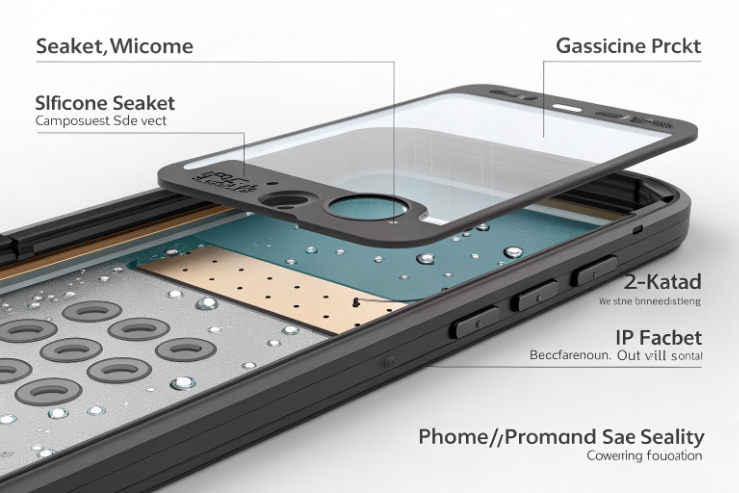
Enclosure material choices that help ESD
- 316L stainless enclosure: usually the easiest ESD path because the touch surface is conductive and can be bonded into the equipotential system. It also tolerates offshore corrosion better, which keeps bonding stable for years.
- Powder-coated metal: the paint layer can act like an insulator. That is not a problem if bonding points are designed correctly (clean metal contact at lug zones and gasket lands), but it must be intentional.
- GRP / plastics: can be excellent for corrosion, but ESD control depends on resin system, additives, and surface finish. In hazardous areas, electrostatic charge control may require material limits and safe-use guidance from IEC TS 60079-32-1 electrostatic hazards guidance 3.
Gasket design that prevents both leaks and floating panels
A gasket is not only a water seal. It also controls mechanical stability of the door or faceplate. If the faceplate “floats,” ESD finds sensitive gaps.
Good practices include:
- recessed gasket grooves so the gasket is protected from UV and abrasion
- stable compression zones so a metal bezel keeps contact integrity
- avoiding long thin plastic lips that can crack and become ESD hot spots
Grounding and bonding: the shortest path wins
An ESD discharge is a fast event. A long ground wire with loops acts like an inductor. That raises peak voltage at the electronics even when the phone is “grounded.”
Practical ESD-hardening choices for Ex telephones include:
- external grounding lug bonded to the local equipotential bonding bar with a short, protected conductor (installed per IEC 60079-14 explosive atmospheres installation requirements 4)
- 360° shield termination for shielded Ethernet where EMC demands it
- bonding of cable armor via gland earth tags when armored cables are used
- keeping gland plates, brackets, and enclosure at the same potential, especially offshore
A design lever table that helps engineers and buyers talk
| Design lever | What it improves | Typical failure it reduces |
|---|---|---|
| Conductive touch surface (metal bezel) | Lowers charge build-up | User-touch resets |
| Clean bonding point (paint-free lug land) | Lower impedance discharge path | Random CPU resets |
| Recessed gasket + stable flange | Mechanical stability + sealing | Intermittent bonding and leaks |
| Shield/armor bonding plan | Common-mode ESD control | PHY damage, link drops |
| Anti-static plastics/coatings where needed | Electrostatic hazard reduction | Charging risk on non-metal parts |
This is also where ATEX/IECEx reality matters: non-metallic external parts can trigger electrostatic hazard considerations, and some products carry “special conditions” about cleaning and charging. ESD robustness and electrostatic safety can be solved together, but only when the design is intentional.
The last step is documentation. Without the right files, ESD claims cannot survive procurement review, site acceptance, or warranty discussions.
What documentation should suppliers provide—ESD test reports, EMC/CE files, and results across temperature extremes?
A one-line datasheet claim is not proof. For long-life hazardous deployments, documentation is part of uptime.
Ask for an IEC 61000-4-2 test report with test points and performance outcomes, an EMC/CE technical file summary (where applicable), and additional robustness evidence after thermal and humidity conditioning for harsh outdoor service.
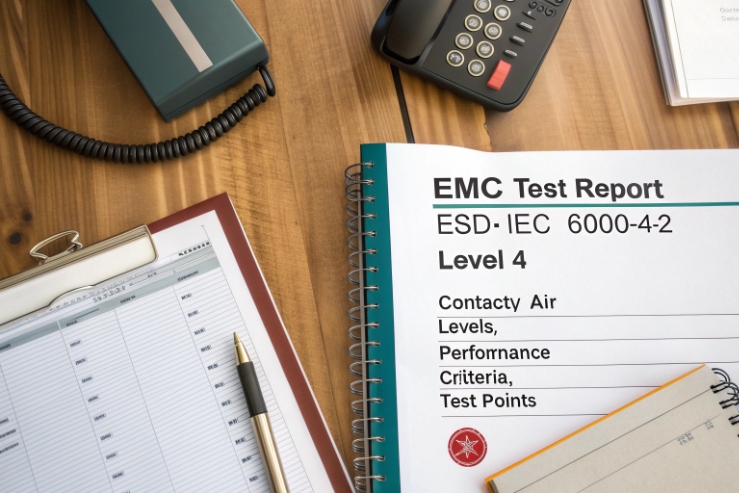
What a real ESD test report should contain
A useful report includes:
- standard and edition used (IEC 61000-4-2)
- test levels for contact and air
- discharge count, polarity, and locations
- coupling plane tests performed (indirect discharges)
- lab environmental conditions during testing
- performance criterion applied and observed behavior (reset, audio glitch, self-recovery time)
If a supplier only provides a “Pass” line, request the point list and the observation log. ESD failures are often local to one seam, one bezel corner, or one port shield bond.
EMC/CE file expectations for Ex telephones
Explosion-proof certification does not replace EMC compliance where EMC rules apply. For EU shipments, buyers often expect evidence aligned to the EMC Directive 2014/30/EU 5, including traceable test reports and declared standards used.
Temperature extremes: what is reasonable to request
IEC 61000-4-2 compliance testing is normally performed in controlled lab conditions. Still, harsh outdoor projects benefit from extra evidence:
- run temperature cycling per IEC 60068-2-14 temperature change test methods 6
- perform ESD tests again after conditioning
- verify that gasket compression, bonding resistance, and shield termination did not drift
This approach is practical because many field ESD issues appear only after aging: corrosion raises impedance, gaskets relax, and coatings creep into bonding points.
A documentation checklist that fits tenders
| Document | Minimum content | Why it matters |
|---|---|---|
| IEC 61000-4-2 report | Points list, levels, criteria, observations | Proves real system immunity |
| EMC test summary | Standard list + results table | Supports compliance review |
| CE/DoC (if applicable) | Directive and harmonized standards list | Procurement traceability |
| Post-conditioning evidence | ESD after thermal/humidity conditioning | Shows long-term robustness |
| Installation notes | Bonding, shielding, gland requirements | Keeps “as-tested” and “as-installed” aligned |
For long-life deployments, also require compliance-ready document control that matches EU-style technical documentation retention and availability expectations 7.
With this package, vendor comparisons become clean, and long-term deployments have fewer surprise resets.
Conclusion
Specify IEC 61000-4-2 Level 4 with clear A/B criteria, then back it with Ex-safe bonding, smart material choices, and test reports that match the installed condition.
Footnotes
-
Official IEC publication page to anchor ESD test method, levels, and repeatable lab setup expectations. ↩︎ ↩
-
Generic industrial immunity reference for describing performance criteria language consistently in procurement specs. ↩︎ ↩
-
Guidance on electrostatic hazards, charging risk, and safe-use considerations for non-metallic parts in explosive atmospheres. ↩︎ ↩
-
Core installation reference for Ex sites, including bonding/earthing expectations and “as-installed” integrity. ↩︎ ↩
-
EU directive overview defining EMC disturbance and immunity expectations for equipment placed on the EU market. ↩︎ ↩
-
Temperature change testing method used to validate ruggedness before re-checking ESD behavior after conditioning. ↩︎ ↩
-
Practical guidance on required technical documentation and retention duties that support audit-ready EMC/CE evidence packages. ↩︎ ↩








